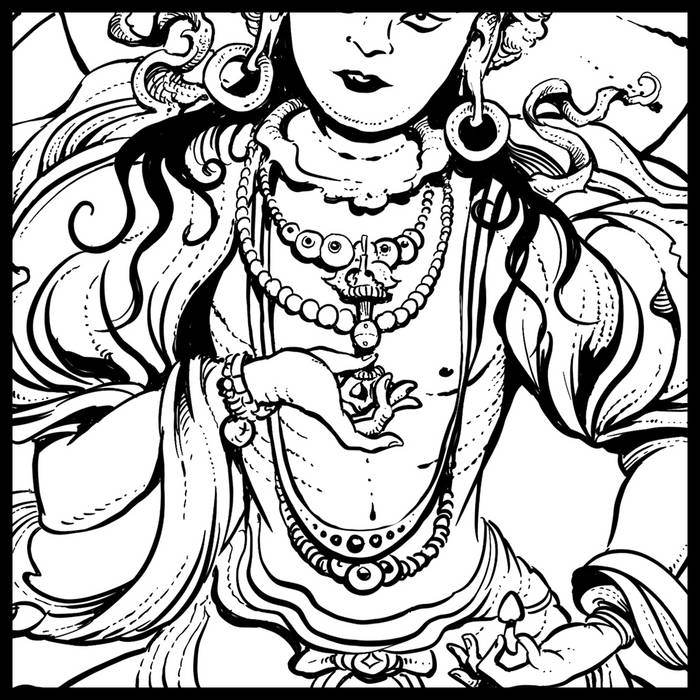
VIBING VAJRASATTVA
FREE ONLINE
INFORMATION SESSION
Sunday, December 4th, 6:00 pm EST
Join us for this free online information session where we will unpack the program and answer all your questions. Register here to receive the free Zoom link for this meeting.
PROGRAM DESCRIPTION BELOW
VIBING VAJRASATTVA: Weekend RetreatFebruary 6th - 8th
(somewhere out of town, but near NYC)
Live vibraphone by Chris Dingman
With guided meditation and support from
Doc Kelley and Doula Daphne McWilliams
Guest lectures by Lama Mike Crowley
Vibing Vajrasattva is a sonic-based psychedelic approach to Buddhist sādhanā practice that features a four-week incubation period of mostly autonomous practice, culminating in an in-person group weekend retreat, followed by online integration. These three phases — incubation, invocation, and integration — which we've dubbed our "Third Eye Approach" are inspired by the Vajrayāna Buddhist Mahāsiddha model in ancient India and Tibet.
The Mahāsiddha practitioners, a largely autonomous group of social misfits, were remarkable for their diversity of composition (coming from all walks of life and occupations) and for their tradition of periodically gathering as a sangha to hold space for the Tantric Feast (Skt. gaṇacakra Tib. tsok), a sensory-rich community engagement with the sādhanā believed to have included amṛta; possibly a psychoactive elixir used in sacraments on a large scale in the Buddhist world during the Middle Ages.
Our Third Eye Approach is also an evolution of Timothy Leary’s psychedelic protocol of “set and setting,” wherein the "set" includes the 4-week incubation phase in which the practitioner fosters a deep and personal connection with the practice in preparation for the more conventional "set and setting" on the day of the Tantric Feast (or weekend retreat).
The Third Eye Approach
1. IncubationIncludes: our Satellite Sangha Kit, featuring (among other things) a DIY, handmade paper Vibing Vajrasattva sādhanā and a studio-recorded audio track performed by Chris Dingman and Doc Kelley. And four group zoom video meetings (1 x week), led by Doc with guest lectures by Lama Mike Crowley and Chris Dingman (time and day TBD).
2. Invocation
Includes an in-person weekend retreat featuring two nights of food and lodging at an out-of-town location.
3. Integration
Includes two follow-up Zoom video meetings for the group, featuring integration circles intended to support post-retreat practice.
This program is not intended to substitute the traditional Buddhist preliminary (ngöndro) practice of reciting 100,000 Vajrasattva mantras. There is no empowerment or refuge ceremony for this program, which is open to both Buddhists and non-Buddhists.
ABOUT THE PRACTICE
"Vajrasattva (rDo-rje sems-dpa’) practice is a tantric meditation done for the purification of karma. As a Mahayana practice, it is undertaken with a bodhichitta aim to purify all our karma in order to reach enlightenment as quickly as possible in order to be best able to help all limited beings (sentient beings). On an ultimate level, Vajrasattva practice is non-conceptual meditation on voidness (emptiness). On a provisional level, it entails repeated recitation of a hundred-syllable mantra (yig-rgya), accompanied by opponent states of mind and complex visualizations."
"Vajrasattva mantra recitation and visualization may be undertaken merely within the context of sutra practice, before beginning any practice of tantra. In such cases, it may be done either with or without being part of a set of formal “preliminary practices” (sngon-‘gro; “ngondro”) for tantra, during which we would repeat the mantra 100,000 times. The recitation and visualization may also constitute part of a formal tantric “sadhana” (sgrub-thabs) practice for actualizing ourselves as a Buddha-figure (yi-dam). Such sadhana practice may be within the context of any class of tantra."
--Dr. Alexander Berzin
READ MORE HERE
ABOUT THE VIBRAPHONIST
Chris Dingman is a New York-based vibraphonist and composer. Chris Dingman is known for his distinctive approach to the instrument, which is at once sonically rich and conceptually expansive. In his captivating solo performances, he casts an enveloping atmosphere, creating layers of simultaneous sound that take listeners to a transcendent place. Chris has worked with the legendary artists Herbie Hancock and Wayne Shorter and many other of today’s jazz and world music luminaries. Based in NYC since 2002, Chris had been documenting his solo improvisations privately for many years. When his father entered hospice care in 2018, he created the 5-hour extended album Peace. This led to an ongoing evolution of his solo music and his critically acclaimed albums Journeys Vol. 1 and Vol. 2. Chris actively tours and has performed worldwide. He has been profiled by NPR, the New York Times, AMNY, and many other publications. He has received fellowships and grants from Chamber Music America, New Music USA, South Arts, and the Thelonious Monk Institute.
The vibraphone is a percussion instrument that looks like a xylophone but has aluminum bars instead of wood. The vibraphone player uses one or two mallets (beaters) in each hand to strike the bars. Underneath each bar is a tube or “resonator” with an electric motor that helps create a unique resonance. In the hands of sonic shaman Chris Dingman, the vibes become a powerful tool for subtle bodywork that is incredibly intimate — yet without physical touch.
ABOUT DOC KELLEY
Doc Kelley is a scholar of Buddhism and a part-time professor in religious studies at Eugene Lang College of Liberal Arts, The New School University. He is also the co-founder of Psychedelic Sangha and lives in Brooklyn, NYC.
Doc received a Ph.D. in Religion from Columbia University, where he studied Indo-Tibetan Buddhism with Robert A. F. Thurman. Before attending graduate school, he was a “dharma bum” who traveled across Asia and initially practiced Buddhism at Kopan Gompa in Kathmandu and later at Sermey Monastery in India. He did his first Heruka-Vajrasattva retreat at the FPMT Tushita Dharma Center in Dharamsala 1997.
ABOUT DOULA DAPHNE MACWILLIAMS (http://daphnemac.com/)
Daphne McWilliams is an End-of-Life Doula who offers calm, compassionate presence to those navigating death and grief. Daphne received certificates in End-of-Life Doula Training under Henry Fersko-Weiss in 2023 and through the International End-of-Life Doula Association (INELDA) in 2024.
She also received the Companion Animal End-of-Life Doula Professional Certificate from the Osher Center for Integrative Health at The University of Vermont (2025). Her work honors each person’s story, helping them find meaning, comfort, and dignity in life’s final chapter.
ABOUT LAMA MIKE CROWLEY
Mike has 55 years experience of meditation and 33 years ago was ordained as lama (teacher) of the Tibetan Kagyud lineage. At the request of his teacher (Lama Radha Chime Rinpoche), he heads the North American branch of his organization called Amrita Dzong.
As a lama, he is authorized to teach all Buddhist philosophies and meditations. However, he was specifically tasked by Lama Chime to be the lineage-bearer of a uniquely Kagyud tradition called "Sutra Mahamudra" which teaches "direct seeing".
DISCLAIMER
Participation in the retreat is conditional on completing the incubation phase and the pre-retreat intake meeting. All sales are final. No refunds are available unless the organizers cancel the event.
All are welcome to register here!
IMAGE: Arik Moonhawk Roper