Bahauddin Dagar: Asynchronous Duets
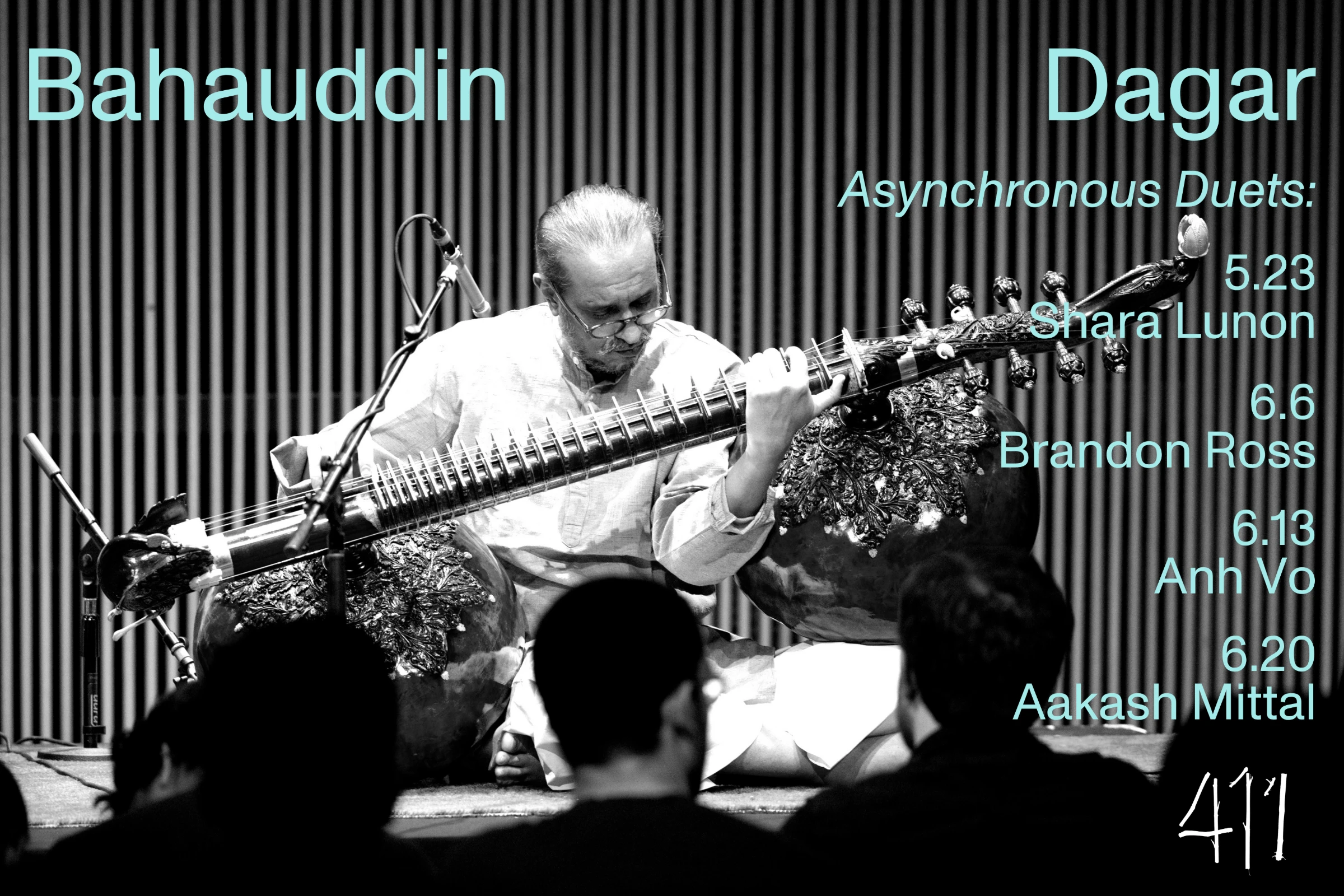
Bahauddin Dagar with:
Shara Lunon (5/23)
Brandon Ross (6/6)
Anh Vo (6/13)
Aakash Mittal (6/20)
2pm - 4:30pm
Doors 1:30pm
873 Broadway, NY, NY 10010, suite 503
FREE
On four Saturday afternoons in May and June, Ustad Bahauddin Dagar, renowned rudra veena player and one of the world’s foremost practitioners of Dhrupad, the oldest living form of Indian classical music, will meet with four New York City-based artists for a series of one-on-one encounters. Framed as asynchronous duets, Ustad Dagar and his collaborators will take turns listening to one another perform and talk about how they approach the fundamental materials of their art, from the perspectives of their personal practices and the historical traditions and communities that inform them. As Ustad Dagar has put it, “frankly, the rudra veena does much more on its home ground and it’s best to see it in that light to be able to understand how far it can outstretch itself.” He continues, “two musical Ideologies will meet and music will run parallel.”
Central to these meetings is the question: How do you engage with one form using the forms you already know? Ustad Dagar’s counterparts represent a cross section of this city’s rich web of performance histories: guitarist Brandon Ross of Black Rock power trio Harriet Tubman, also a longtime collaborator of Henry Threadgill and Cassandra Wilson; vocalist/electronicist Shara Lunon of improv cooperative History Dog and the incendiary punk band Blasé; Vietnamese decolonialist ritual performance artist Anh Voh; and Aakash Mittal, a saxophonist and composer whose research has spanned both South Asian classical forms and the multimodal concepts of the revolutionary drummer, martial artist, herbalist and heart “sonocytologist” Milford Graves.
The content and flow of each event, from conversation to music and back, will arise from informal, private meetings between Ustad Dagar and each artist in the week leading up these public events. At each event, audiences will also have a chance to ask questions and engage with the performers.
Part of his ongoing, multi-year collaboration with FourOneOne, this series revives and reimagines the dialogue between the profound tradition of Dagarvani Dhrupad and Western audiences, performers, scholars and students—first initiated in the 1960s by the Senior Dagar Brothers Nasir Moinuddin and Nasir Aminuddin, and continued by his father, Zia Mohiuddin Dagar and uncle Zia Fariduddin Dagar, and others from the 1970s through the present day.
Dhrupad communicates principally through the emotions expressed in its characteristic structures, long, achingly subtle melodic unfoldings that eventually yield to ecstatic, rhythmically explosive passages. A performance is at once spontaneous and deeply grounded in the framework of the raga (“that which colors the mind”). Ideally, the performer becomes a channel, allowing both themselves and the audience to inhabit states analogous to the “pure bliss of the realization of reality.” This is, above all, a music of feeling, one that has engaged listeners from all over the world at the deepest possible levels. In New York, more than a half century ago, the Dagars caught the ears of jazz trail blazers Don Cherry and Sonny Rollins, both of whom sought out Zia Mohiuddin Dagar in Mumbai for informal training.